



Seed production in EU - 2025
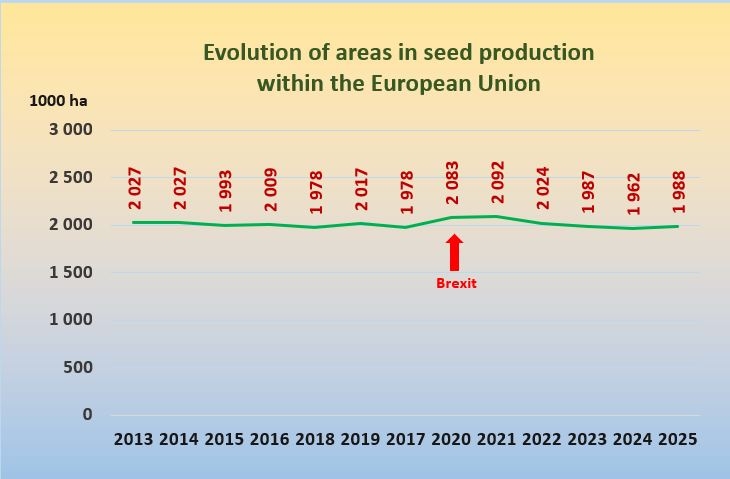
In 2025, after two years of decline, the area approved for field crop seed production (1) within the European Union showed slight growth, reaching 1,987,503 hectares (1.5%). This trend mirrors the growth in cereal acreage, which represents 49% of the total area (excluding specialty vegetables and flowers). This trend benefits a large majority of countries, notably France (+3%), Germany (+6%), and Hungary (+6%).
(1) Excluding vegetables
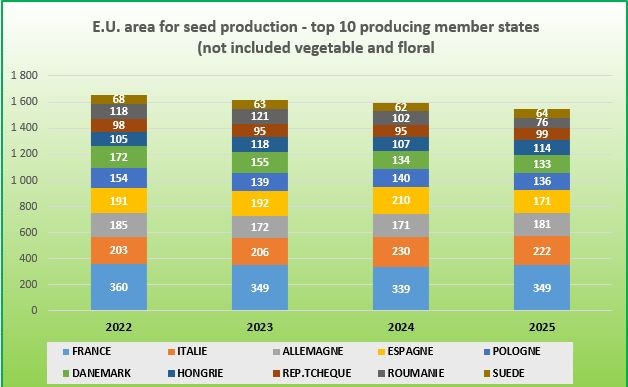
France remains the EU leader with 349,252 ha (3%), ahead of Italy (221,751 ha; -4%), Spain (212,133 ha; +1%) and Germany (181,093 ha; +6%).
France remains the world’s leading producer of arable crop seeds. It retains its leadership in maize, oilseeds, fibre crops and pulses. Spain remains the leader in straw cereals, ahead of Italy and France. Denmark dominates the market for forage grasses, Italy that for small-seed legumes and beet, and the Netherlands that for seed potatoes.
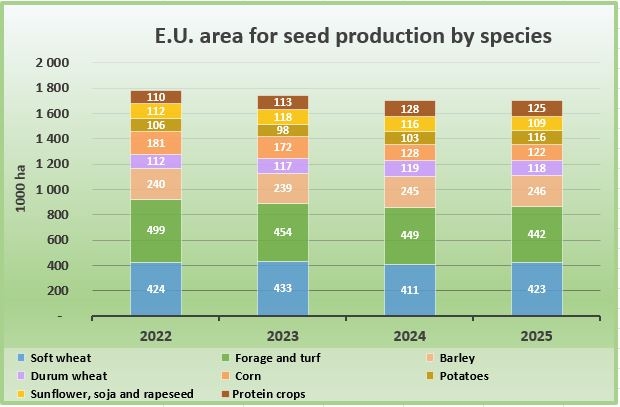
Straw cereals are well ahead with a total of 975,591 ha, representing 49% of cultivated land excluding fine vegetables and flowers. Having been in decline since 2020, the trend is now rising again, by 3%, to total 975,591 ha. This situation is mainly due to a 3% increase in the area under soft wheat (422,729 ha), combined with a 12,6% rise in oats (63,614 ha), in triticale (+14% ; 60 161 ha) and remarkable growth in spelt, where the area has more than doubled to reach 5,715 ha.
Spain remains the leading producer of straw cereals with 136,833 ha (+7%), ahead of Italy (119,356 ha; -1.6%) and France (118,791 ha; +4%). France remains the leading producer of soft wheat with 65,876 ha (+2.6%), ahead of Germany (47,841 ha; +11%) and Spain (40,881 ha; +6%). Spain remains the leader in the barley market with 49,797 ha (+2.3%), ahead of France (33,076 ha; +8%) and Germany (32,372 ha; +3.7%). Durum wheat acreage has changed little (-0,8%) to reach 118,167 ha. This follows the trend in Italy, the market leader, where areas fell slightly by 2% to 69,218 ha. Spain followed the trend (-3.7%; 17,510 ha), while Greece increased by 2% to 14,919 ha and France fell by 11% to 5 498 ha. There was a 50% increase in Hungary, amounting to 3,167 ha. Oat acreage grew by 12.7% to 63,614 ha, benefiting the vast majority of EU countries, notably Spain, the leading producer, where acreage rose significantly to total 10,457 ha (+31%), ahead of Sweden (+9%; 8,025 ha) and Finland (+8%; 7,567 ha).
Since 2021, maize acreage has been steadily declining, falling from 190,270 ha in 2021 to 122,233 ha in 2025 (-5%). This trend affects half of the EU countries, with the exception of France, the leading producer of this crop, where acreage is set to increase by 2% to 65,076 ha. Austria has seen remarkable growth of 16,5% to 10,228 ha, ahead of Italy (+7%; 6,598 ha). Conversely, Romania and Hungary, the second and third largest producers, have been following a downward trend since 2022, and have respectively experienced a drop of 30% (12,745 ha) and 20% (12,505 ha).
The downward trend in oilseed crops continues. The cultivated area has decreased by 3.2%, totaling 123,238 hectares. This trend is mainly driven by sunflower, whose area has fallen by 20% to 29,378.5 hectares. Rapeseed area is down 4% to 22,319 hectares. Soybean area, up 2%, totals 58,159 hectares. It is also worth noting a 33% rebound in oilseed flax, reaching 4,909 hectares.
The area under soya has increased by 2.2% to 58,159 ha. This trend is evident in the majority of countries. Italy, the leading producer of this crop, covers a total of 16,377 ha (+3.9%). Next comes Hungary, which, for the second consecutive year, has seen a remarkable increase of 17.6% to 7,546 ha, ahead of Croatia (7,546 ha; -4.4%), Austria (5,931 ha; +3.1%) and France (5,418 ha ; -2%)
Sunflower acreage has fallen for the second year running, reaching 29 379 ha, a drop of 20%. This is due to a significant decline among the main producers, including France, which saw a 19% fall to 12,781 ha, followed by Spain (-30%; 7,435 ha) and Romania (-14%; 3,682 ha). Conversely, the trend is on the rise again in Hungary (+10%; 1,171 ha).
For rapeseed, the area under cultivation fell by 4% to 22,319 ha. Most countries saw an increase in the area under cultivation, but the trend was driven by France, the leading producer of this crop, which recorded a 14.6% drop to 10,076 ha, followed by Spain (-7%; 4,795 ha). Italy has seen its acreage fall by 46% to 411 ha. Significant increases offset the declines observed, notably in Germany (+10%; 2,902 ha) and in Ireland, where acreage has doubled to reach 929 ha.
The area under fodder crops has fallen by -1,6% to 441,513 ha. This trend is due to a decline across most species, with the exception of ‘other fodder crops’, notably phacelia, for which the area has surged by 39% to 19,652 ha. This trend affects the vast majority of countries, notably the main supplier countries such as Denmark, the leading producer of these species, where the area under cultivation has been declining since 2023. By 2025, it will have fallen by 6.2% to 71,154 ha, ahead of Italy (-9.4%; 60,496 ha), Poland (-13.8%; 40,467 ha), Hungary (+6,4% ; 37 155 ha) and Spain (-1.7%; 36,088 ha).
The area under forage grasses has declined for the third consecutive year, totalling 175,984 ha, a fall of 4.5%. This trend affects the vast majority of countries, particularly the main supplier countries such as Denmark, the leading producer of these species, where the area has fallen by 6.7% to 63,549 ha, ahead of Germany (-0.5%; 18,975 ha) and Poland (-13.6%; 17,117 ha). Significant increases were observed in the Netherlands (+13%; 8,477 ha), Spain (6,341 ha; +17%), Lithuania (+39%; 4,214 ha) and Latvia (+14.2%; 4,110 ha).
53% of the total area is covered by ryegrass. English ryegrass dominates with 50,397 ha (-11%), ahead of Italian ryegrass (39,294 ha; +6.5%). Next come fescues, down by 4.3% to 42,387 ha, mainly red fescue (17,716 ha; -6.5%) and tall fescue (15,889 ha; +2.5%).
Following a remarkable 16% increase in 2024, the area under small-seed legumes remained stable (+0.7%) at 166,729 ha. This trend is the result of significant declines, particularly in Italy (-8%; 53,104 ha) and France (-2.0%; 22,063 ha), the two leading producing countries. Added to this are losses in Poland (-76%; 1,716 ha), Denmark (-3%; 6,462 ha), and Germany (-8.5%; 3,770 ha). By contrast, significant increases were observed in Hungary (28.6%; 17,334 ha), the Czech Republic (+15%; 16,640 ha), Spain (+22%; 11,872 ha) and Lithuania (+36%; 9,816 ha).
This trend is mainly driven by clover crops, which have fallen by 9.2% to 78,521.5 ha. This trend is primarily driven by Egyptian clover, whose area has fallen by 20% to 20,265 ha, and red clover, down by 8% to 25,767 ha. Alfalfa, the dominant species within the EU, has increased by 11% to 86,613 ha.
After recording remarkable growth in 2024 (+54%), large-seeded legumes fell by 6% to 51,442 ha. These are mainly vetches, the area under which fell by 6.4% to 50,738,5 ha. Common vetch, which accounts for the vast majority, totalled 30,199 ha (-21%), ahead of hairy vetch (15,073 ha; +12%). Spain dominates the market for large-seeded pulses. Down by 16%, its area stands at 17,523 ha, ahead of Lithuania and Greece, which have seen increases of 34.5% to 7,740 ha and 10% to 7,216.5 ha respectively. There has been a notable decline in Italy (-34%; 3,400 ha) and Poland (-13%; 3,376 ha).
For the second year running, the area under brassicas has seen a downward trend (-12%), totalling 26,371 ha. This trend affects the vast majority of countries, including Poland, the leading producer, which recorded a 15.7% decline to 8,258 ha, ahead of Hungary (-20%; 4,516 ha). Increases were seen in the Czech Republic (+2%; 4,499 ha), Germany (+28%; 2,005 ha) and Finland (+32%; 460 ha). The trend is mainly driven by fodder radish, down by 14.6% to 12,577 ha, and mustard (12,392 ha; -11.5%). Turnip rape shows a remarkable increase of 64% to 1,281 ha.
Potato acreage has increased for the second consecutive year, totalling 116,146 ha, a rise of 13%. This trend is evident in the vast majority of countries, notably the Netherlands, the leading producer, where acreage has risen by 7% to 41,185 ha, ahead of France (+11%; 23,652 ha), Germany (+17%; 20,491 ha), Poland (+22.5%; 7,694.5 ha) and Denmark (+23.5%; 7,402 ha).
The area under protein crops fell by 2,7% to 113,765 ha. Peas (forage and protein crops) remained relatively stable at 74,458 ha (+2.6%), whilst field beans rose by 3.8% to a total of 32,446 ha. As for lupins, they have fallen significantly (31%) to a total of 6,861 ha. Germany, where the area under cultivation fell by 14% to 14,628 ha, has lost its leading position to Spain, which now covers 16,063 ha (-1.8%). The Czech Republic recorded a 4.6% increase to 11,849 ha, ahead of France (+5.3%; 11,779 ha). Significant increases were seen in Latvia (+53%), Greece (+28%) and Hungary (+44%).
Flax acreage has seen remarkable growth, totalling 64,795 ha (+15%). This growth is evident across the vast majority of countries. It is mainly fibre flax, with acreage rising by 14% to 59,886 ha. Its highest level ever. To a lesser extent, after falling by 36% in 2024, oilseed flax is following the trend and has seen a 32.9% increase to 4,910 ha.This trend is driven by France, the leading producer, where the area under cultivation has seen a remarkable increase of 15.6% to 53,906 ha, its highest level ever. In Belgium, acreage remains relatively stable at 4,243 ha (+0.4%) and in the Netherlands, it has increased by 4.1% to 2,452 ha. In Hungary, acreage under oilseed flax has doubled (1,332 ha).
Sugar beet, acreage has fallen again to a total of 11,214 ha, a decline of 10.2%. Sugar beet, which accounts for the majority, fell by 11.5% to 10,474 ha, whilst fodder beet rebounded (+13%) to a total of 739.5 ha. Taking both types together, the trend is driven by the top two producing countries, led by Italy, where acreage fell by 22% to 5,487 ha, ahead of France, which saw an increase of 5.7% to 4,920 ha.
The area under pulses (beans, lentils, chickpeas and garden peas) increased by 4.9% to a total of 11,499 ha. This trend is driven by chickpeas, whose area increased by 11% to a total of 7,172 ha, ahead of lentils, which remained stable at 3,114 ha, and garden peas, which fell by 15% to cover 1,068 ha. Finally, beans, down by 2.6%, remain marginal at 145 ha.
France, the leading country for these species, saw a slight decline of 1.4% to 5,239 ha. It is followed by Italy, which once again recorded remarkable growth (+50%) to reach 2,764 ha, ahead of Spain (+6%; 1,449 ha) and Hungary, which fell by 8% to 1,108 ha.
Summary note made by SEMAE (France)